
Saturday, November 04, 2006


Friday, November 03, 2006

Some Better Experiences in Paris

After our early disappointments (see http://restchallenge.blogspot.com/) we buckled down and seriously considered where we would be eating. In general, we avoid Michelin 2 and 3 star restaurants as painfully expensive and overly formal (both a result of the Michelin grading standards). A recent development has been the opening of more informal bistros by famous chefs that do not try to meet the Michelin standards. L'Atelier Maitre Albert, that disappointed us last week, is from Guy Savoy. We will be trying several more over the next few weeks.
Le Florimond is a thoroughly enjoyable restaurant in the 7th, near the Invalides. This is not an area we go to frequently because I don't like the ambiance as it's the HQ for many government offices. However, the review of this restaurant was good in both Michelin and Zagats. The restaurant is small and the staff was just delightful, a good sense of humor and repartee.
Overall this has been our best dining experience thus far. I started with a excellent foie gras and chicken giblets with salad. It was delicious and the salad was fresh (not always true in Paris, the French are not lovers of green vegetables). Chris had a mushroom and escargot terrine topped with cepes in a cream sauce. Delicious!
For the main course, Chris had "Chou Farci" (stuffed cabbage, there's no accounting for taste). It was quite good, and just like her grandma's. I had a much more traditional Perdreau (partridge) in a delicious stew. The bread was great and we had a very nice Burgundy (Beaune). The person beside us had an "assiette du chocolate" which looked like heaven for the chocolate lovers out there. The menu can be had for 35E.
An added bit of fun was a splendid view of the twinkling Eiffel tower viewed down the rue St. Dominique. The buildings on either side framed the tower perfectly.
Le Florimond
19, av de la Motte-Picquet
Paris 7, France
01 45 55 40 38
Le Christine is a delightful small bistro in an old Parisian house near the Odeon. Service is good and friendly in the packed small rooms. The buzz is definitely ���tourist���. The kitchen is open behind glass and it���s amazing that they can deliver beautifully prepared dishes to such a large crowd. If you go, ask to be seated in the back room, hopefully next to the window by the courtyard.
My starter, a vegetable tart, was excellent. Chris had a warm goat cheese on toast (she���s a sucker for warm goat cheese). Mine was better! (Only in his opinion!)
We shared a beautifully prepared whole bass in a salt crust served with a side of mashed potatoes (a Chris favorite). Unusually, we shared dessert (an orange souffl��) that was outstanding. I only wished we had ordered two. Our meal was complimentd by a bottle of Sancerre.
Zagat Review
Off the beaten path and oozing charm. Near the Odeon.
1, rue Christine
Paris 6 , France
01 40 51 71 64
Le Petit Pontoise is a wonderful Parisian bistro in the Latin Quarter, about a ten minute walk from our apartment. They specialize in French 'comfort food' if you can believe that. It's a small room and always crowded but the staff is friendly and helpful (everything is listed on blackboards around the room).
Christina started with a warm fig stuffed with roquefort cheese on a bed of greens (not all that fresh) and I had sauteed mushrooms (girolles) and garlic (lots of garlic!). We followed with scallops sauteed on a medley of vegetables. My Magret de Canard (duck breast) with roasted potatoes came in it's own casserole. Both were excellent. Our wine this evening was a Beaujolais (Morgon 2005).
The people at the next table were visiting from Minnesota (!) and we had nothing in common with them except the language and a love of Paris. They were both consultants working for the non-profit sector. He takes 100 mile bike rides, hikes, marathons and mountain climbs. Fortunately, they also eat! It was a fun evening, sharing good food, favourite places to wander and shops we have each enjoyed.
Zagat Review
Wow. exclaim enthusiasts of this wonderful, unspoiled Parisian bistro in the Latin Quarter
9, rue de Pontoise
Paris , France
01 43 29 25 20

Thursday, November 02, 2006
A visit to the Musee Picasso
 The Musée Picasso is situated in the Marais in the heart of Paris. It is the largest Picasso collection in the world, including several thousand paintings, sculptures, drawings, ceramics, engraving, and even poetry. After his death in 1973, many of Picasso's works went to the French state in settlement of taxes. These are "Picasso's Picassos," not necessarily his most famous works, but rather the paintings and sculptures he kept and valued most. It also covers the artists personal collection of work by friends and influences such as Matisse, Braque, Cézanne, and Rousseau.
It is a relatively small and manageable museum and we go every time we are in Paris. The only drawback are the crowds. We were there on a Thursday afternoon in November and it was crowded! On the other hand, I am always fascinated by how much we learn each time we go about the various periods and genres of his life. I started by "knowing" that I liked his more classical work and drawings and did not like the Cubist or Surrealist works. However, each time I see them and listen carefully to the Audio-Guide, I grow to really like specific works - although mostly the later Surrealist works.
This special exhibit, from the collection of a German-American dealer/collector named HEINZ
 BERGGRUEN included several hundred new works that we had never seen before (mostly from the Berlin Museum). The painting at right, The Yellow Pullover, is a good example. It is a painting of the photographer/activist/lover Dora Maar. You can really see (after listening to ten minutes of explanation) what she "looked" like and how he saw her. The almost armor-like sweater, the searching eyes, the tense hands, the beautiful hair. But most importantly, you grow to like her and feel you know her.
By the way, this makes the third exhibit we've seen this year of the collected works of a dealer. I wonder if that's a coincidence? It also makes you wonder how the dealers do business that they are able to accumulate such enormous, and valuable, collections. Maybe the artists are right not to trust them.
5 r. de Thorigny </DIV>
Paris- 75003
Telephone: 01 42 71 25 21
Telephone: 01 42 71 25 21
Why we go to Paris - for our health!
Red wine holds key to health
November 2, 2006
Yes, Red Wine Holds Answer. Check Dosage.
By NICHOLAS WADE
Can you have your cake and eat it? Is there a free lunch after all, red wine included? Researchers at the Harvard Medical School and the National Institute on Aging report that a natural substance found in red wine, known as resveratrol, offsets the bad effects of a high-calorie diet in mice and significantly extends their lifespan.
Their report, published electronically yesterday in Nature, implies that very large daily doses of resveratrol could offset the unhealthy, high-calorie diet thought to underlie the rising toll of obesity in the United States and elsewhere, if people respond to the drug as mice do.
Resveratrol is found in the skin of grapes and in red wine and is conjectured to be a partial explanation for the French paradox, the puzzling fact that people in France enjoy a high-fat diet yet suffer less heart disease than Americans.
The researchers fed one group of mice a diet in which 60 percent of calories came from fat. The diet started when the mice, all males, were a year old, which is middle-aged in mouse terms. As expected, the mice soon developed signs of impending diabetes, with grossly enlarged livers, and started to die much sooner than mice fed a standard diet.
Another group of mice was fed the identical high-fat diet but with a large daily dose of resveratrol (far larger than a human could get from drinking wine). The resveratrol did not stop them from putting on weight and growing as tubby as the other fat-eating mice. But it averted the high levels of glucose and insulin in the bloodstream, which are warning signs of diabetes, and it kept the mice’s livers at normal size.
Even more striking, the substance sharply extended the mice’s lifetimes. Those fed resveratrol along with the high- fat diet died many months later than the mice on high fat alone, and at the same rate as mice on a standard healthy diet. They had all the pleasures of gluttony but paid none of the price.
Scientists have long known that a moderate intake of alcohol, and red wine in particular, is associated with a lowered risk of heart disease and other benefits. More recently, scientists began to suspect resveratrol had particularly powerful effects and began investigating its role in lifespan.
The researchers, led by David Sinclair and Joseph Baur at the Harvard Medical School and by Rafael de Cabo at the National Institute on Aging, also tried to estimate the effect of resveratrol on the mice’s physical quality of life. They gauged how well the mice could walk along a rotating rod before falling off, a test of their motor skills. The mice on resveratrol did better as they grew older, ending up with much the same staying power on the rod as mice fed a normal diet.
The researchers hope their findings will have relevance to people too. Their study shows, they conclude, that orally taken drugs “at doses achievable in humans can safely reduce many of the negative consequences of excess caloric intake, with an overall improvement in health and survival.”
Several experts said that people wondering if they should take resveratrol should wait until more results were in, particularly from safety tests in humans. Another caution is that the theory about why resveratrol works is still unproved.
“It’s a pretty exciting area, but these are early days,” said Dr. Ronald Kahn, president of the Joslin Diabetes Center in Boston.
Information about resveratrol’s effects on human metabolism should be available a year or so, Dr. Kahn said, adding, “Have another glass of pinot noir — that’s as far as I’d take it right now.”
The mice were fed a hefty dose of resveratrol, 24 milligrams per kilogram of body weight. Red wine has about 1.5 to 3 milligrams of resveratrol per liter, so a 150-lb person would need to drink 750 to 1,500 bottles of red wine a day to get such a dose.
Dr. Richard Hodes, director of the National Institute on Aging, which helped support the study, also said that people should wait for the results of safety testing. Substances that are safe and beneficial in small doses, like vitamins, sometimes prove to be harmful when taken in high doses, Dr. Hodes said.
One person who is not following this prudent advice, however, is Dr. Sinclair, the chief author of the study. He has long been taking resveratrol, though at a dose of only five milligrams per kilogram. Mice given that amount in a second feeding trial have shown similar, but less pronounced, results as those on the 24-milligram-a-day dose, he said.
Dr. Sinclair has had a physician check his metabolism, because many resveratrol preparations contain possibly hazardous impurities, but so far no ill effects have come to light. His wife, his parents, and “half my lab” are also taking resveratrol, he said.
Dr. Sinclair declined to name his source of resveratrol. Many companies sell the substance, along with claims that rivals’ preparations are inactive. One such company, Longevinex, sells an extract of red wine and knotweed that contains an unspecified amount of resveratrol. But each capsule is equivalent to “5 to 15 5-ounce glasses of the best red wine,” the company’s Web site asserts.
Dr. Sinclair is the founder of a company, Sirtris Pharmaceuticals, that has developed several chemicals intended to mimic the role of resveratrol but at much lower doses. Sirtris has begun clinical trials of one of these compounds, an improved version of resveratrol, with the aim of seeing if it helps control glucose levels in people with diabetes.
“We believe you cannot reach therapeutic levels in man with ordinary resveratrol,” said Dr. Christoph Westphal, the company’s chief executive.
Behind the resveratrol test is a considerable degree of scientific theory, some of it well established and some yet to be proved. Dr. Sinclair’s initial interest in resveratrol had nothing to do with red wine. It derived from work by Leonard Guarente of the Massachusetts Institute of Technology, who in 1995 found a gene that controlled the longevity of yeast, a single-celled fungus.
Dr. Guarente and Dr. Sinclair, who had come from Australia to work as a postdoctoral student in Dr. Guarente’s laboratory, discovered the mechanism by which the gene makes yeast cells live longer. The gene is known as Sir-2 in yeast, sir standing for silent information regulator, and its equivalent in mice and humans is called SIRT-1.
Dr. Guarente then found that the gene’s protein needed a common metabolite to activate it, and he developed the theory that the gene, by sensing the level of metabolic activity, mediates a phenomenon of great interest to researchers in aging, the greater life span caused by caloric restriction.
Researchers have known since 1935 that mice fed a calorically restricted diet — one with all necessary vitamins and nutrients but 40 percent fewer calories — live up to 50 percent longer than mice on ordinary diets.
This low-calorie-provoked increase in longevity occurs in many organisms and seems to be an ancient survival strategy. When food is plentiful, live in the fast lane and breed prolifically. When famine strikes, switch resources to body maintenance and live longer so as to ride out the famine.
Most people find it impossible to keep to a diet with 40 percent fewer calories than usual. So if caloric restriction really does make people as well as mice live longer — which is plausible but not yet proved — it would be desirable to have some drug that activated the SIRT-1 gene’s protein, tricking it into thinking that days of famine lay ahead.
In 2003 Dr. Sinclair, by then in his own laboratory, devised a way to test a large number of chemicals for their ability to mimic caloric restriction in people by activating SIRT-1. The champion was resveratrol, already well known for its possible health benefits.
Critics point out that resveratrol is a powerful chemical that acts in many different ways in cells. The new experiment, they say, does not prove that resveratrol negated the effects of a high-calorie diet by activating SIRT-1. Indeed, they are not convinced that resveratrol activates SIRT-1 at all.
“It hasn’t really been clearly shown, the way a biochemist would want to see it, that resveratrol can activate sirtuin,” said Matt Kaeberlein, a former student of Dr. Guarente’s who does research at the University of Washington in Seattle. Sirtuin is the protein produced by the SIRT-1 gene.
Dr. Sinclair said experiments at Sirtris had essentially wrapped up this point. But they have not yet been published, so under the rules of scientific debate he cannot use them to support his position. In his Nature article he therefore has to concede that “Whether resveratrol acts directly or indirectly through Sir-2 in vivo is currently a subject of debate.”
Given that caloric restriction forces a trade-off between fertility and lifespan, resveratrol might be expected to reduce fertility in mice. Dr. Sinclair said he saw no such infertility in his experiment, but he said that might be because the mice were not on a low-calorie diet.
If resveratrol does act by prodding the sirtuins into action, then there will be much interest in the new class of sirtuin activators now being tested by Sirtris. Dr. Westphal, the company’s chief executive, has no practical interest in the longevity-promoting effects of sirtuins and caloric restriction.
For the Food and Drug Administration, if for no one else, aging is not a disease and death is not an end-point. The F.D.A. will approve only drugs that treat diseases in measurable ways, so Dr. Westphal hopes to show that his sirtuin activators will improve the indicators of specific diseases, starting with diabetes.
“We think that if we can harness the benefits of caloric restriction, we wouldn’t simply have ways of making people live longer, but an entirely new therapeutic strategy to address the diseases of aging,” Dr. Guarente said.
November 2, 2006
Yes, Red Wine Holds Answer. Check Dosage.
By NICHOLAS WADE
Can you have your cake and eat it? Is there a free lunch after all, red wine included? Researchers at the Harvard Medical School and the National Institute on Aging report that a natural substance found in red wine, known as resveratrol, offsets the bad effects of a high-calorie diet in mice and significantly extends their lifespan.
Their report, published electronically yesterday in Nature, implies that very large daily doses of resveratrol could offset the unhealthy, high-calorie diet thought to underlie the rising toll of obesity in the United States and elsewhere, if people respond to the drug as mice do.
Resveratrol is found in the skin of grapes and in red wine and is conjectured to be a partial explanation for the French paradox, the puzzling fact that people in France enjoy a high-fat diet yet suffer less heart disease than Americans.
The researchers fed one group of mice a diet in which 60 percent of calories came from fat. The diet started when the mice, all males, were a year old, which is middle-aged in mouse terms. As expected, the mice soon developed signs of impending diabetes, with grossly enlarged livers, and started to die much sooner than mice fed a standard diet.
Another group of mice was fed the identical high-fat diet but with a large daily dose of resveratrol (far larger than a human could get from drinking wine). The resveratrol did not stop them from putting on weight and growing as tubby as the other fat-eating mice. But it averted the high levels of glucose and insulin in the bloodstream, which are warning signs of diabetes, and it kept the mice’s livers at normal size.
Even more striking, the substance sharply extended the mice’s lifetimes. Those fed resveratrol along with the high- fat diet died many months later than the mice on high fat alone, and at the same rate as mice on a standard healthy diet. They had all the pleasures of gluttony but paid none of the price.
Scientists have long known that a moderate intake of alcohol, and red wine in particular, is associated with a lowered risk of heart disease and other benefits. More recently, scientists began to suspect resveratrol had particularly powerful effects and began investigating its role in lifespan.
The researchers, led by David Sinclair and Joseph Baur at the Harvard Medical School and by Rafael de Cabo at the National Institute on Aging, also tried to estimate the effect of resveratrol on the mice’s physical quality of life. They gauged how well the mice could walk along a rotating rod before falling off, a test of their motor skills. The mice on resveratrol did better as they grew older, ending up with much the same staying power on the rod as mice fed a normal diet.
The researchers hope their findings will have relevance to people too. Their study shows, they conclude, that orally taken drugs “at doses achievable in humans can safely reduce many of the negative consequences of excess caloric intake, with an overall improvement in health and survival.”
Several experts said that people wondering if they should take resveratrol should wait until more results were in, particularly from safety tests in humans. Another caution is that the theory about why resveratrol works is still unproved.
“It’s a pretty exciting area, but these are early days,” said Dr. Ronald Kahn, president of the Joslin Diabetes Center in Boston.
Information about resveratrol’s effects on human metabolism should be available a year or so, Dr. Kahn said, adding, “Have another glass of pinot noir — that’s as far as I’d take it right now.”
The mice were fed a hefty dose of resveratrol, 24 milligrams per kilogram of body weight. Red wine has about 1.5 to 3 milligrams of resveratrol per liter, so a 150-lb person would need to drink 750 to 1,500 bottles of red wine a day to get such a dose.
Dr. Richard Hodes, director of the National Institute on Aging, which helped support the study, also said that people should wait for the results of safety testing. Substances that are safe and beneficial in small doses, like vitamins, sometimes prove to be harmful when taken in high doses, Dr. Hodes said.
One person who is not following this prudent advice, however, is Dr. Sinclair, the chief author of the study. He has long been taking resveratrol, though at a dose of only five milligrams per kilogram. Mice given that amount in a second feeding trial have shown similar, but less pronounced, results as those on the 24-milligram-a-day dose, he said.
Dr. Sinclair has had a physician check his metabolism, because many resveratrol preparations contain possibly hazardous impurities, but so far no ill effects have come to light. His wife, his parents, and “half my lab” are also taking resveratrol, he said.
Dr. Sinclair declined to name his source of resveratrol. Many companies sell the substance, along with claims that rivals’ preparations are inactive. One such company, Longevinex, sells an extract of red wine and knotweed that contains an unspecified amount of resveratrol. But each capsule is equivalent to “5 to 15 5-ounce glasses of the best red wine,” the company’s Web site asserts.
Dr. Sinclair is the founder of a company, Sirtris Pharmaceuticals, that has developed several chemicals intended to mimic the role of resveratrol but at much lower doses. Sirtris has begun clinical trials of one of these compounds, an improved version of resveratrol, with the aim of seeing if it helps control glucose levels in people with diabetes.
“We believe you cannot reach therapeutic levels in man with ordinary resveratrol,” said Dr. Christoph Westphal, the company’s chief executive.
Behind the resveratrol test is a considerable degree of scientific theory, some of it well established and some yet to be proved. Dr. Sinclair’s initial interest in resveratrol had nothing to do with red wine. It derived from work by Leonard Guarente of the Massachusetts Institute of Technology, who in 1995 found a gene that controlled the longevity of yeast, a single-celled fungus.
Dr. Guarente and Dr. Sinclair, who had come from Australia to work as a postdoctoral student in Dr. Guarente’s laboratory, discovered the mechanism by which the gene makes yeast cells live longer. The gene is known as Sir-2 in yeast, sir standing for silent information regulator, and its equivalent in mice and humans is called SIRT-1.
Dr. Guarente then found that the gene’s protein needed a common metabolite to activate it, and he developed the theory that the gene, by sensing the level of metabolic activity, mediates a phenomenon of great interest to researchers in aging, the greater life span caused by caloric restriction.
Researchers have known since 1935 that mice fed a calorically restricted diet — one with all necessary vitamins and nutrients but 40 percent fewer calories — live up to 50 percent longer than mice on ordinary diets.
This low-calorie-provoked increase in longevity occurs in many organisms and seems to be an ancient survival strategy. When food is plentiful, live in the fast lane and breed prolifically. When famine strikes, switch resources to body maintenance and live longer so as to ride out the famine.
Most people find it impossible to keep to a diet with 40 percent fewer calories than usual. So if caloric restriction really does make people as well as mice live longer — which is plausible but not yet proved — it would be desirable to have some drug that activated the SIRT-1 gene’s protein, tricking it into thinking that days of famine lay ahead.
In 2003 Dr. Sinclair, by then in his own laboratory, devised a way to test a large number of chemicals for their ability to mimic caloric restriction in people by activating SIRT-1. The champion was resveratrol, already well known for its possible health benefits.
Critics point out that resveratrol is a powerful chemical that acts in many different ways in cells. The new experiment, they say, does not prove that resveratrol negated the effects of a high-calorie diet by activating SIRT-1. Indeed, they are not convinced that resveratrol activates SIRT-1 at all.
“It hasn’t really been clearly shown, the way a biochemist would want to see it, that resveratrol can activate sirtuin,” said Matt Kaeberlein, a former student of Dr. Guarente’s who does research at the University of Washington in Seattle. Sirtuin is the protein produced by the SIRT-1 gene.
Dr. Sinclair said experiments at Sirtris had essentially wrapped up this point. But they have not yet been published, so under the rules of scientific debate he cannot use them to support his position. In his Nature article he therefore has to concede that “Whether resveratrol acts directly or indirectly through Sir-2 in vivo is currently a subject of debate.”
Given that caloric restriction forces a trade-off between fertility and lifespan, resveratrol might be expected to reduce fertility in mice. Dr. Sinclair said he saw no such infertility in his experiment, but he said that might be because the mice were not on a low-calorie diet.
If resveratrol does act by prodding the sirtuins into action, then there will be much interest in the new class of sirtuin activators now being tested by Sirtris. Dr. Westphal, the company’s chief executive, has no practical interest in the longevity-promoting effects of sirtuins and caloric restriction.
For the Food and Drug Administration, if for no one else, aging is not a disease and death is not an end-point. The F.D.A. will approve only drugs that treat diseases in measurable ways, so Dr. Westphal hopes to show that his sirtuin activators will improve the indicators of specific diseases, starting with diabetes.
“We think that if we can harness the benefits of caloric restriction, we wouldn’t simply have ways of making people live longer, but an entirely new therapeutic strategy to address the diseases of aging,” Dr. Guarente said.
Tuesday, October 31, 2006
Le Cirque d'Hiver

 I'm a real circus junky so when Irv and Iris recommended we go to "Le Cirque d'Hiver" I didn't miss a beat and reserved seats - front row and center - even though we weren't planning on kidnapping a little kid off the street to bring along! On the appointed day, there we were amidst a zillion kids (it's holiday week here), parents and sundry other folk.
This is the winter home of the European travelling circus. It's an opulent permanent "tent" complete with a full orchestra, clever announcers and showgirls who entertained the audience as the runners prepared for the next act. It's a one ring circus a little like our own "Big Apple Circus" in NYC.
We had a lot of fun watching the snowy tigers perform not more then 3 feet from our seats! There were the usual 'jongleurs', 'trapezistes, 'chevaux' (dancing horses) an
 d of course, the clowns. We enjoyed everything. Chris was thrilled to be able to understand some of the jokes. We especially enjoyed a 'ventriloque' who made you think a live dog was talking and the juggler who worked with 6 white balls that he bounced on the floor so fast it looked like they were attached to strings. There were also two amazing Chinese 'equilabristes' who twisted their bodies into unbelievable shapes while they balanced on each other and twirled parasols and cloth disks from every part of their bodies. At one point one girl was bent over backwards on the floor on one foot and hand while spinning disks from the others. The other girl was standing on her hand on her hip while twirling disks from her other three extremeties. It was remarkable!
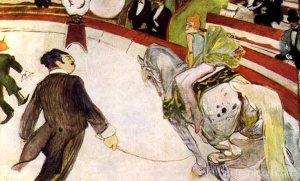
At right is a Toulouse-Lautrec painting of the Cirque from the 1880's.
The whole experience was magic--when the lights dimmed every kid had twirling light-wands that made the room sparkle (Paul wouldn't let me get one).
Le Cirque d'Hiver
110 rue Amelot
Paris 11

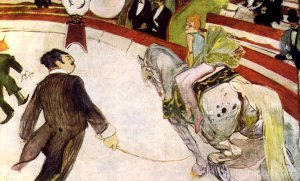
Toulouse-Lautrec Painting of Cirque d'hiver
Saturday, October 28, 2006
Parking - Un Sport de Payee
Anyone visiting Paris will be amazed by the skill and expertise with which residents park in this  city. There's no space too small or inaccessible for the determined. Parking is a creative activity where the sport seems to be in how many vehicles can fit on any given street. Here t
 here seems to be pride in squeezing a car into a spot that requires 'kissing' the bumpers of the car in front or in back of you. Drivers sometimes require several minutes to maneuver into position holding up traffic on the narrow streets. It's surprising how patient people are, perhaps they identify with those parking! For anyone spotting a space, it's not unthinkable to witness them drive diagonally through traffic to secure the coveted spot! Pedestrians beware! It's no wonder that many sidewalks are lined with stanchions or poles to avoid assertive drivers pulling right up onto the sidewalks. Mind you, this doesn't seem to inhibit those with scooters or motorbikes. It is not uncommon to have to scramble to get out of
  the way of someone on a scooter on the sidewalk! Please look at the picture at the right. The flower pots are at the edge of the sidewalk. The yellow truck is driving in the road. The cars are parked on the sidewalk. The scooter is driving on the sidewalk. The woman with the baby carriage is trying to not get hit.
Believe it or not, they have traffic police in Paris who are supposed to give tickets for illegal parking. But we can not figure out when they ticket and why. We think these may be the same guys that issue tickets to those who fail to stoop and scoop! We have seen a car booted but we expect this is for extreme cases where a car has been left for a very long time blocking the road.
 city. There's no space too small or inaccessible for the determined. Parking is a creative activity where the sport seems to be in how many vehicles can fit on any given street. Here t
 here seems to be pride in squeezing a car into a spot that requires 'kissing' the bumpers of the car in front or in back of you. Drivers sometimes require several minutes to maneuver into position holding up traffic on the narrow streets. It's surprising how patient people are, perhaps they identify with those parking! For anyone spotting a space, it's not unthinkable to witness them drive diagonally through traffic to secure the coveted spot! Pedestrians beware! It's no wonder that many sidewalks are lined with stanchions or poles to avoid assertive drivers pulling right up onto the sidewalks. Mind you, this doesn't seem to inhibit those with scooters or motorbikes. It is not uncommon to have to scramble to get out of
  the way of someone on a scooter on the sidewalk! Please look at the picture at the right. The flower pots are at the edge of the sidewalk. The yellow truck is driving in the road. The cars are parked on the sidewalk. The scooter is driving on the sidewalk. The woman with the baby carriage is trying to not get hit.
Believe it or not, they have traffic police in Paris who are supposed to give tickets for illegal parking. But we can not figure out when they ticket and why. We think these may be the same guys that issue tickets to those who fail to stoop and scoop! We have seen a car booted but we expect this is for extreme cases where a car has been left for a very long time blocking the road.
Our worst dinner in Paris - Chez Omar
This is a "couscous" restaurant". One of the best-rated in Paris. Zagats loves it (see comments below). We were sitting between two tables of Brits who recommended the Couscous "Royale" for two and the Legumes (vegetarian). We should have known better. The Royale was sort of a "mixed grill of all the meats they serve. The vegetables were primarily carrots, chickpeas, zucchini and celery.

It was the worst meal we have had in Paris in years. The meat tasted like it had been boiled with the fat providing the only flavor. The only exception were two lambchops that had been grilled and were tasty. The six lamb sausages were so salty we couldn't them. The vegetables, not having any fat, were boiled beyond any taste or texture.
We did have fresh strawberries for dessert that were good.
I can't imagine where Zagats got its ratings. I can only believe tourists were drawn by the large portions at reasonable prices.

It was the worst meal we have had in Paris in years. The meat tasted like it had been boiled with the fat providing the only flavor. The only exception were two lambchops that had been grilled and were tasty. The six lamb sausages were so salty we couldn't them. The vegetables, not having any fat, were boiled beyond any taste or texture.
We did have fresh strawberries for dessert that were good.
I can't imagine where Zagats got its ratings. I can only believe tourists were drawn by the large portions at reasonable prices.
Chez Omar
47, rue de Bretagne
47, rue de Bretagne
Paris 11, France
01 42 72 36 26
For “couscous at its most trendy”, check out this “casual” “fashion-industry favorite” in the 11th, where plates are “piled high” with “pleasant” Moroccan morsels, the “jovial” owner makes “you feel like a local on your first” visit and the “waiters never stop joking around”; the place is usually “packed” and they “don’t take reservations”, but “don’t be turned off by the line that often extends out the door” – it’s “worth the wait.”
Friday, October 27, 2006
French Lessons
 During our stay this year, I decided to spend some time in the classroom working on my French. Each morning I spend an hour and a half with a a teacher and a group of three. The groups have changed some over the time I've been here. The cuurent teacher, Arnaud is young, patient and a force to be reckoned with--she does NOT like to hear an English word being spoken. At first, I felt I was making steady progress. It's now the end of my fourth week, and I feel I've 'hit the wall' so to speak. Nothing that comes out of my mouth seems correct; I mix up my verbs and pronouns, and have a thing about using 'sur' when I should be using 'dans'! It's enough to make me want to 'jette mes papiers dans la rue'! One of the dail
 y exercises is to listen to a tape and report on what was said, I'm hopeless!--I hear a completely different story then anyone else. And Paul tells me that this is how I am in English--can you believe he said that???? The other students, currently a young 23 year old from London and an equally young person from Hong Kong are, I seem to be doing better then me. I try not to be too hard on myself; they are both taking two classes a day; and Vickie is living with a French family. BUT! Je ne parle pas bien! Or at least not as 'bien' as I would like. The group teases me about my "Franglais". When I can't think of the word in French, I substitute English! It's always worked for me when speaking German to my mother! I've got one more week and then it will be time to 'retourne aux l'Etats-Unis'. I'm hoping not lose what I've learned before we return next year, so let me know if you speak French and would like to 'parler'.
A bientot,
Christina
L'Orangerie reopens after six years
We were fortunate to be in Paris when the l'Orangerie Museum finally opened after six years of renovations. The name refers to the original purpose of the building to store the Tuileries Garden citrus trees during the winter.
-----------------------
 The collection of Impressionist paintings of art dealer Paul Guillaime has been moved to the basement to open up the top floor to allow natural light to bathe the Monet Water Lillies. It includes impressionist works from Cézanne, Renoir, Picasso, Soutine, Derain and Henri Rousseau and others. We were particluarly interested because we had recently seen an exhibit, at the Met in NY, of the collection of another dealer in Impressionist works, Ambroise Vollard. The quality of the collections and the complex relationships they had with the artists they represented were faschinating. Both started with relatively little money but accumulated large fortunes and incredible art collections - to the envy of their clients.

On the ground floor, two large oval rooms are devoted to the fabulous Water Lilies by Claude Monet. Each room contains eight canvases that surround the oval room with a vision of the famous waterlilies at his home in Giverny. A major part of the renovation was the removal of the second floor of the museum which had been added in the 1960's and blocked the natural light that Monet had cherished. Because of the large size of the paintings (painted for these rooms), they could not be moved and were left in place during the six years of renovations. The curator was quoted as saying:
"The most important thing for us was the restoration of natural light,
which was so fundamental to Monet. The study of light is the basis of the
Impressionist movement, so we wanted to restore that as the essence of this
building, which was once described as the Sistine Chapel of Impressionism".
Musee l'Orangerie
Place de la Concorde
-----------------------
 The collection of Impressionist paintings of art dealer Paul Guillaime has been moved to the basement to open up the top floor to allow natural light to bathe the Monet Water Lillies. It includes impressionist works from Cézanne, Renoir, Picasso, Soutine, Derain and Henri Rousseau and others. We were particluarly interested because we had recently seen an exhibit, at the Met in NY, of the collection of another dealer in Impressionist works, Ambroise Vollard. The quality of the collections and the complex relationships they had with the artists they represented were faschinating. Both started with relatively little money but accumulated large fortunes and incredible art collections - to the envy of their clients.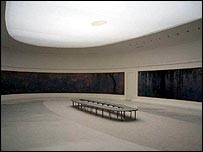
On the ground floor, two large oval rooms are devoted to the fabulous Water Lilies by Claude Monet. Each room contains eight canvases that surround the oval room with a vision of the famous waterlilies at his home in Giverny. A major part of the renovation was the removal of the second floor of the museum which had been added in the 1960's and blocked the natural light that Monet had cherished. Because of the large size of the paintings (painted for these rooms), they could not be moved and were left in place during the six years of renovations. The curator was quoted as saying:
"The most important thing for us was the restoration of natural light,
which was so fundamental to Monet. The study of light is the basis of the
Impressionist movement, so we wanted to restore that as the essence of this
building, which was once described as the Sistine Chapel of Impressionism".
Musee l'Orangerie
Place de la Concorde
Thursday, October 26, 2006
Our new Paris home (for six weeks!)
One of our most important tasks each year before we leave Paris is to decide on our apartment for the next year. This is a major task as the number of neighborhoods, apartments and price ranges is enormous. Each year we get a little better, and a little bit more discriminating, in where we stay. The first year we picked the apartment after meeting someone at Monet's house in Givernais. That apartment, in the Rue du Tresor in the Marais, was wonderful and we still see Irv and Iris when we are back in Paris. Our first apartment and neighborhood will always be a special place for us.
But, each year as we go back, we try to find something a little bit different and/or in a different neighbourhood. Chris spends hours at the computer scouting possibilities. By now, this will be our fifth year, we have pretty well determined our priorities;

 All Parisian apartments have big doors on the street side. If your lucky, it will have nice courtyard (rather than parking and recycling bins). This aparment has an attractive courtyard but not one that's usable.
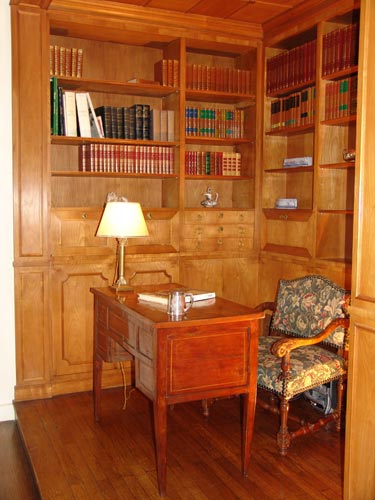
One of the things we're most excited about is it has a lovely little library off the living room where you can work or read. The panelling is original and aparently installed by the same craftsman that did the White House! Not having seen that room, I'm not sure whether that's a recommendation - but it looks beautiful.


But, each year as we go back, we try to find something a little bit different and/or in a different neighbourhood. Chris spends hours at the computer scouting possibilities. By now, this will be our fifth year, we have pretty well determined our priorities;
- A "Parisian" apartment in a nice neighborhood in proximity to a nice Cafe, Boulangerie and Tabac (for the newspaper) - we want to be in a place that is clearly Parisian in feel
- A comfortable bed - queen or king size
- A shower - the French like tubs
- High speed internet access - a must for me
- Comfortable chairs where you can read - really important when you don't watch TV
- A central neighborhood - we like to walk everywhere
- Fully equipped kitchen, DW, Clothes washer - Chris must be able to cook and wash our clothes.
These are probably not surprising. What may be more surprising is what is not a priority for us,
- An elevator - frequently really old, but desirable; buildings cannot esthetically be fitted for elevators. Parisians accept this. Often elevators are so small that our bodies touch on all sides--definitely not something Christina goes in willingly!
- A second bedroom. Nice, but not required. However, the last two apartments have had two bedrooms and bathrooms.
Not surprisingly, everything is available, it just costs more. So, rather than getting cheaper as we get more experienced, it gets more expensive. Chris spends some time almost everyday, on-line looking for apartments and arranging for us to visit them. This year we visited six apartments before agreeing on one that seems to be very special. It's a 17th century "Hotel Particulare" (not sure what this means exactly, but it's old and special). It's on the banks of the Seine facing the city.

 All Parisian apartments have big doors on the street side. If your lucky, it will have nice courtyard (rather than parking and recycling bins). This aparment has an attractive courtyard but not one that's usable.
One of the things we're most excited about is it has a lovely little library off the living room where you can work or read. The panelling is original and aparently installed by the same craftsman that did the White House! Not having seen that room, I'm not sure whether that's a recommendation - but it looks beautiful.

Breakfast, Lunch and Dinner...

Life in Paris has been a little different this year because each morning I go off for a French lesson leaving Paul sleeping in bed. In past years, our usual routine was for one of us to fetch the newspaper and morning ‘baguette’ while the other made coffee. Breakfast can be the pricey at a nice Café, so we like to do it ourselves. Compare the cost of an entire French bread (no more then 1.05 E.) with 17.50 E. for 2 cups of coffee and a baguette with butter and jam at a Café.
Here on the Island, a great spot for breakfast or a light meal any time of the day, is “Le Flore de L’Ile” located at the top of the street overlooking the Pont de Tournelle and the back of Notre Dame. It’s a wonderful place to watch people; and it seems to be a favorite kissing corner! The menu offers everything from a near perfect omelet, the French favorite, Berthillon ice cream and a great cup of tea or coffee. The food is fresh and served by friendly staff who bring your coffee with delicious dark chocolate kisses.
 If you’ve had breakfast (especially at 10 o’clock) you really only need a little snack in the afternoon to tide you over to dinner. We love the comfort of a wine bar where you can sample a variety of vintages, share a plate of cheese and/or Charcuterie (sliced smoked meats) and soak up the atmosphere. We’ve been to several, but especially like a casual place called “Juveniles”. This tiny little spot has less then a dozen tables for 2 with wine crates stacked along the walls. Wines are available by the glass with selections from France, Australia and even California Zinfandels. They don’t serve any French cheeses, but the selection is good, the salads fresh and you can share tapas style meals that include sausages and smoked meats. We’ve found the food to be good, the prices reasonable and you can even carry off a bottle of wine. It’s the perfect way to end an afternoon.
Here on the Island, a great spot for breakfast or a light meal any time of the day, is “Le Flore de L’Ile” located at the top of the street overlooking the Pont de Tournelle and the back of Notre Dame. It’s a wonderful place to watch people; and it seems to be a favorite kissing corner! The menu offers everything from a near perfect omelet, the French favorite, Berthillon ice cream and a great cup of tea or coffee. The food is fresh and served by friendly staff who bring your coffee with delicious dark chocolate kisses.
Le Flore en l'Ile
42, quai d'Orléans
Paris 2, France 75004
01 43 29 88 27
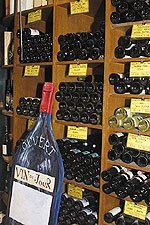 If you’ve had breakfast (especially at 10 o’clock) you really only need a little snack in the afternoon to tide you over to dinner. We love the comfort of a wine bar where you can sample a variety of vintages, share a plate of cheese and/or Charcuterie (sliced smoked meats) and soak up the atmosphere. We’ve been to several, but especially like a casual place called “Juveniles”. This tiny little spot has less then a dozen tables for 2 with wine crates stacked along the walls. Wines are available by the glass with selections from France, Australia and even California Zinfandels. They don’t serve any French cheeses, but the selection is good, the salads fresh and you can share tapas style meals that include sausages and smoked meats. We’ve found the food to be good, the prices reasonable and you can even carry off a bottle of wine. It’s the perfect way to end an afternoon.
47, rue de Richelieu
Paris 1, France
01 42 97 46 49
Our favorite new dinner spot is Le Reminet, located within walking distance of our apartment.  They require reservations and it’s buzzing each night. The service is slow even for French standards, but once you settle in with a bottle of wine it’s worth the wait. On our first visit, starters included roasted quail served on a bed of mixed greens (delicious) and a carrot soup which was tasty but not as good as the quail. For the main course, Paul opted for Perdreau (partridge, he’s very fowl lately!) which again was also roasted and served with turnip and a triangle of rosti potatoes that he had to fight me for! My fish fillet (mystery fish colcosse?) was beautifully prepared served with a light creamy sauce along side a creamy risotto and sautéed fennel. As usual, we skipped dessert but saw some incredible chocolate things, soufflés and poached figs that looked wonderful. They offered some interesting “vin do moment” and we enjoyed a nice Cote de Rhone.
 They require reservations and it’s buzzing each night. The service is slow even for French standards, but once you settle in with a bottle of wine it’s worth the wait. On our first visit, starters included roasted quail served on a bed of mixed greens (delicious) and a carrot soup which was tasty but not as good as the quail. For the main course, Paul opted for Perdreau (partridge, he’s very fowl lately!) which again was also roasted and served with turnip and a triangle of rosti potatoes that he had to fight me for! My fish fillet (mystery fish colcosse?) was beautifully prepared served with a light creamy sauce along side a creamy risotto and sautéed fennel. As usual, we skipped dessert but saw some incredible chocolate things, soufflés and poached figs that looked wonderful. They offered some interesting “vin do moment” and we enjoyed a nice Cote de Rhone.
 3, rue des Grands-Degrés
Paris 5, France
01 44 07 04 24
Sunday, October 22, 2006
Some new restaurants and an old favorite
Juvéniles
47, rue de Richelieu
Paris 1, France
01 42 97 46 49
Réminet
3, rue des Grands-Degrés
Paris 5, France
01 44 07 04 24
Flore en l'Ile (Le)
42, quai d'Orléans
Paris 2, France 75004
01 43 29 88 27
47, rue de Richelieu
Paris 1, France
01 42 97 46 49
Réminet
3, rue des Grands-Degrés
Paris 5, France
01 44 07 04 24
Flore en l'Ile (Le)
42, quai d'Orléans
Paris 2, France 75004
01 43 29 88 27
Friday, October 20, 2006
What's wrong (or right) with this picture
Christina and I have often written about how much we enjoy walking in Paris. This year, Chris brought a pedometer and she's averaging almost 5 miles a day. That sounds like a lot (it is) but what you may not realize is that half of that distance is because we often get lost going somewhere. For those used to a simple grid system, the 'snail' grid of Paris can be a nightmare.


If you look at the map of NYC on the left, you notice that the streets are neat and orderly. They basically follow a commonsense grid with Avenues going North and South and Streets going East and West. Normally, the streets start at one river and end at the other. The avenues continue to a logical end (water or a Park). There are exceptions in lower Manhattan but this is the general rule. The outer boroughs follow different rules but there are still rules.
The map at the right represents Paris. Streets are not in a grid, but converge in lovely squares with Cafes and parks. Only a few key streets traverse the city, usually follow ing an arc rather than a straight line. Street names are assigned to commemorate people or events.

 ing an arc rather than a straight line. Street names are assigned to commemorate people or events.
 This might still be manageable if it wasn't that they've been doing this for 700 hundred years. As a result, in the Centre Ville area, streets change names every chance they get. It's rare for a local street to keep its name for more than a few blocks. And, unlike New York, where these commemorative names exist mostly as decorative signs under the "real" street sign, these names are the only names used. There are literally thousands of street names. The 'Plan de Paris' has a 148 PAGES. That's approximately 6,000 names! for a boy from NYC that's culture shock!
For two people as "directionally-challenged" as Christina and I, it's a nightmare. We each have a map (really a book - the "pocket version has 96 pages!). Even with a map we frequently get lost. One of the hardest lessons to learn is that, because the streets are at odd angles to each other, you can't "go around the corner". It may take you 500 meters away from where you were (1/3 of a mile) with no easy way back. We've noticed in recent years that even the cab drivers have GPS! As difficult as it is, after four years, we're getting to know our way around the neighbourhoods--at least the ones where we've stayed. Christina manages to get back and forth to school and the market without any problems (at least none that she's sharing with me)!

Thursday, October 19, 2006
Jazz in Paris
Chris and I love going to Cabarets in New York and when we're travelling. We enjoy the relative intimacy of being close to performers who like to have a 'conversation' with the audience. It's always been frustrating to us that, outside of New York there are often more bars and clubs with live entertainment . Sure, the big name performers (e.g. Eartha Kitt, Andrea Marcovicci, Michael Feinstein, John Pizzarelli) all come to the famous NY cabarets (Oak Room, Cafe Carlyle, the new Dizzy's Club Coca Cola). But, while we enjoy going to them, we are envious of the more informal (and seriously less expensive) venues we experience elsewhere.
There are many more Jazz clubs in Paris than in New York. As a result, many performers in the US have performed in Paris early in their careers. There may not have gotten a lot of money, but they could appear before an audience. We wrote earlier about our evening at Les Fous des L'Ile near our apartment. But one of our longtime favorites is a little bit fancier -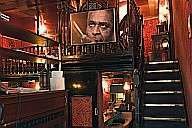 Le Bilboquet, near St. Germain des Pres. This small, intimate, room decorated with red velvet walls and chairs (perhaps to resemble a cat-house) draws a nightly capacity crowd. As is typical with this type of club the world over, the food is over-priced and under-delivered. But the bar is a different story. There are a number of small (really small) tables with small (really, really, small) chairs arranged around the stage. There is open seating here with no cover charge, and only a one drink minimum. The drinks are expensive (about $25) but you can stay pretty much all night (entertainment starts at 9:00). The limiting factor seems to be how long you can stand the chair! The other night we saw a black African Jazz singer with a three piece band. We were sitting about 10 feet away and really enjoyed it. More often then not, we're next to someone interesting and can share a story or two in French (Chris' is getting better) or English. This is one of our favorite places and we've gone back every year.
There are many more Jazz clubs in Paris than in New York. As a result, many performers in the US have performed in Paris early in their careers. There may not have gotten a lot of money, but they could appear before an audience. We wrote earlier about our evening at Les Fous des L'Ile near our apartment. But one of our longtime favorites is a little bit fancier -
 Le Bilboquet, near St. Germain des Pres. This small, intimate, room decorated with red velvet walls and chairs (perhaps to resemble a cat-house) draws a nightly capacity crowd. As is typical with this type of club the world over, the food is over-priced and under-delivered. But the bar is a different story. There are a number of small (really small) tables with small (really, really, small) chairs arranged around the stage. There is open seating here with no cover charge, and only a one drink minimum. The drinks are expensive (about $25) but you can stay pretty much all night (entertainment starts at 9:00). The limiting factor seems to be how long you can stand the chair! The other night we saw a black African Jazz singer with a three piece band. We were sitting about 10 feet away and really enjoyed it. More often then not, we're next to someone interesting and can share a story or two in French (Chris' is getting better) or English. This is one of our favorite places and we've gone back every year.
Tuesday, October 17, 2006
Being outside in Paris
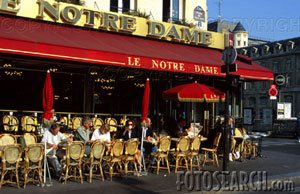
Christina and I constantly talk about how Paris is an "outside" city like no other. People in Paris seem to use the out of doors as an extension of their inside living space; to meet friends, to eat, to walk, or just to sit and read the paper. The streets and parks are always crowded with people just being - at all hours of the day and into the night.
In New York, living in mid-town we walk to many places, and occasionally eat out when the weather's nice and the place attractive.
In Paris, the reverse is true, you eat outside, at Cafes and Brasseries all year long. They just turn on the heaters! Many small places extend their 'petit' indoor seating area to the out of doors to accomodate twice the numbers possible inside. Outdoor street markets can be found in many neighbourhoods on any given day of the week and there's live outdoor entertainment where ever a crowd might be found (often on selected streets which have been closed off during the weekend).
Here, there are many words to describe how you get about, from 'faire du jogging", to faire une promenade. No matter what the weather, people are out of doors, not only walking but riding their bikes, rollerblading (they close off many streets on Sunday just for this purpose), or strolling along the Boulevards, window shopping or in the many parks found throughout the city. Luxembourg Gardens is packed with families and individuals all day, 7 days a week. We often wonder 'whose minding the store' because it seems that nobody's working especially on a sunny day. Benches line Boulevards and streets and you can find comfortable, even reclining chairs in many of the larger parks. These chairs and benches are often on the periphery of the fountains, gardens and the grass. Here the 'Park Police' ensure that you don't sit on the grass except in small designated areas. Not only can you find places to sit, play or participate in a sport, a bonus is that there are an abundance of clean toilet facilities everywhere.

On Sundays, it seems that all of Paris is outdoors as they promenade up and down the street at selected spots (we don't know how they're selected). Ile Saint Louis is one of those spots. Six days a week it's loaded with tourists, but on Sunday the locals are out and take over the street and the line at the Berthillon ice cream shop often circles the block.
The bottom line is we've adapted and are outside more then in and have logged many miles so far.
Friday, October 06, 2006
BERLIN
So, here we are at the end of a long day of seeing the sights of Berlin. Why Berlin you ask?? Well, this was the only route available to get to Paris, Business Class, using air miles, so we decided to stay a couple of days. Like Paris and New York, Berlin is a great place to walk. Our hotel, the Ritz Carlton is on the Potsdamer Platz, formerly in ‘East Berlin’. East Berlin has been completely rebuilt in the last 10 years and this area, especially, is the site of new, very modern, skyscrapers. Opposite us is the fabulous Sony Center pictured above. It’s a maze of walkways, cafes, cinemas and shops.
Our arrival coincided with the Berlin Marathon which finished just down the road from our hotel. As a result, there was no car access and we had to schlep our suitcases (6 weeks of clothes!) through throngs of well-wishers to our hotel. However, right after we checked in we walked to the finish line area and rewarded ourselves with a glass of ‘Berliner Pils’ and a “wurst”. It always amazes us to watch older people complete a marathon looking less winded then we do after a 45 minute workout! They must have better trainers! It couldn’t be anything we do, or don’t do!
Berlin has changed overwhelmingly in the last 15 years. It was interesting to compare what we each remembered from previous visits (Paul’s last time here was 1976, mine in 1991)! When Paul was here, Berlin was a beleaguered city surrounded by East Germany. You needed a passport to visit the East and it was quite frightening to turn over your passport at “Checkpoint Charlie”. On your return, your car was searched for contraband (or people--who were routinely shot trying to escape). On one trip, Paul’s car was searched on the way in and his Hilton and Playboy magazines confiscated as forbidden propaganda. Paul was upset to see that the famous Church that had been preserved as a bombed hulk as a reminder of the war, had been repaired! It’s still called a memorial, but the roof has been closed in and the ceiling inside repaired (albeit poorly). Only the outside has been left alone. Preventing additional damage from the elements seemed like a poor excuse to drastically change a memorial like that. He thinks right-wing nationalists did it to eliminate one of the few remaining signs of the war.
Chris was here just after the wall came down. The East was a grim, rundown area with little business. Now, it’s the showplace of a proud German Republic with huge new government and private buildings. The government was moved here from Bonn, requiring a huge investment in offices and embassies. All is not perfect, however, the city still has an unemployment rate of 17% and is almost bankrupt from the social costs of supporting the social obligations of the East.
We only had one day to sightsee and took one of those split level busses around the city. One interesting thing that we saw was the new Memorial to the Jewish dead in Europe which was within walking distance of our hotel. It’s a field of hundreds of simple gray slabs of stone {looking like tombs) of varying heights (from flat to 10 feet high), arranged in rows, over rolling hills. You can walk between them but quickly lose sight of each other. It’s eerie, I had a moment of panic when Paul and I got separated—it’s not a place for little children. There are no names listed, nor is there much of a description to let you know where you are. Walking between the rows made people there very quiet. On another visit we plan to go into the underground museum that we missed this time. The ‘hop on’, ‘hop off’ bus tour allowed us to manage our whirlwind tour of the city; wandering around the Reichstag (government seat now), Checkpoint Charlie, the Brandenburg Gate, the Memorial Church and of course a stroll down the famous Ku’damm where we peeked into all the designer shops. We had a late afternoon coffee (which means cake is involved) in an outdoor café at the famous Kempinski Hotel. Here and there we saw pieces of the former ‘Wall’ and tried to imagine what it must have been like to live in a city divided.
While here, we wanted to stick to local ‘German’ food since we were heading to Paris for 6 weeks. That was easier said than done. Other than the traditional ‘wursts’ from street vendors and a Weiner Schnitzel at a pseudo-French brasserie we were unable to find any ‘better’ German restaurants – they were all French or Italian! The beer was good, the bread was better and I will miss the incredible yogurt bar at the hotel.
auf weidersein,
Christina & Paul
September 26, 2006
Our arrival coincided with the Berlin Marathon which finished just down the road from our hotel. As a result, there was no car access and we had to schlep our suitcases (6 weeks of clothes!) through throngs of well-wishers to our hotel. However, right after we checked in we walked to the finish line area and rewarded ourselves with a glass of ‘Berliner Pils’ and a “wurst”. It always amazes us to watch older people complete a marathon looking less winded then we do after a 45 minute workout! They must have better trainers! It couldn’t be anything we do, or don’t do!
Berlin has changed overwhelmingly in the last 15 years. It was interesting to compare what we each remembered from previous visits (Paul’s last time here was 1976, mine in 1991)! When Paul was here, Berlin was a beleaguered city surrounded by East Germany. You needed a passport to visit the East and it was quite frightening to turn over your passport at “Checkpoint Charlie”. On your return, your car was searched for contraband (or people--who were routinely shot trying to escape). On one trip, Paul’s car was searched on the way in and his Hilton and Playboy magazines confiscated as forbidden propaganda. Paul was upset to see that the famous Church that had been preserved as a bombed hulk as a reminder of the war, had been repaired! It’s still called a memorial, but the roof has been closed in and the ceiling inside repaired (albeit poorly). Only the outside has been left alone. Preventing additional damage from the elements seemed like a poor excuse to drastically change a memorial like that. He thinks right-wing nationalists did it to eliminate one of the few remaining signs of the war.
Chris was here just after the wall came down. The East was a grim, rundown area with little business. Now, it’s the showplace of a proud German Republic with huge new government and private buildings. The government was moved here from Bonn, requiring a huge investment in offices and embassies. All is not perfect, however, the city still has an unemployment rate of 17% and is almost bankrupt from the social costs of supporting the social obligations of the East.
We only had one day to sightsee and took one of those split level busses around the city. One interesting thing that we saw was the new Memorial to the Jewish dead in Europe which was within walking distance of our hotel. It’s a field of hundreds of simple gray slabs of stone {looking like tombs) of varying heights (from flat to 10 feet high), arranged in rows, over rolling hills. You can walk between them but quickly lose sight of each other. It’s eerie, I had a moment of panic when Paul and I got separated—it’s not a place for little children. There are no names listed, nor is there much of a description to let you know where you are. Walking between the rows made people there very quiet. On another visit we plan to go into the underground museum that we missed this time. The ‘hop on’, ‘hop off’ bus tour allowed us to manage our whirlwind tour of the city; wandering around the Reichstag (government seat now), Checkpoint Charlie, the Brandenburg Gate, the Memorial Church and of course a stroll down the famous Ku’damm where we peeked into all the designer shops. We had a late afternoon coffee (which means cake is involved) in an outdoor café at the famous Kempinski Hotel. Here and there we saw pieces of the former ‘Wall’ and tried to imagine what it must have been like to live in a city divided.
While here, we wanted to stick to local ‘German’ food since we were heading to Paris for 6 weeks. That was easier said than done. Other than the traditional ‘wursts’ from street vendors and a Weiner Schnitzel at a pseudo-French brasserie we were unable to find any ‘better’ German restaurants – they were all French or Italian! The beer was good, the bread was better and I will miss the incredible yogurt bar at the hotel.
auf weidersein,
Christina & Paul
September 26, 2006
Ah, Bread
A day without bread, at least here in Paris is, unthinkable. The French are completely fanatical about it - Parisian’s buy bread as often as three times a day; you can’t use the term boulangerie unless the bread conforms to specific criteria and is made on the premises and the varieties of baguettes alone can boggle the mind (with every term strictly regulated e.g ancienne, traditionelle, bio). No one ever eats day-old bread, or even left-overs from breakfast. Paul is in bread ‘seventh heaven’.
Morning, noon and night, men and women, young and old, head home with long loaves of bread. There’s no bag, instead, an expertly twisted square of paper is wrapped around the middle for you to hold. There are so many types of bread Chris usually looks at what’s available and points! We’ve had some wonderful surprises. Sometimes not, but there’s always tomorrow and another shop just around the corner!
Here on the Ile Saint Louis, we have three boulangeries within a couple of blocks of the apartment. Paul’s favorite bakery, named “Paul” is a little further, but I expect we’ll find ourselves there often. While they can’t claim the boulangerie description, the bread and pastries are exceptional and we just love their sandwiches for lunch – they understand that a sandwich is about the bread, not the filling.
Paul & Christina
September 28, 2006h
Morning, noon and night, men and women, young and old, head home with long loaves of bread. There’s no bag, instead, an expertly twisted square of paper is wrapped around the middle for you to hold. There are so many types of bread Chris usually looks at what’s available and points! We’ve had some wonderful surprises. Sometimes not, but there’s always tomorrow and another shop just around the corner!
Here on the Ile Saint Louis, we have three boulangeries within a couple of blocks of the apartment. Paul’s favorite bakery, named “Paul” is a little further, but I expect we’ll find ourselves there often. While they can’t claim the boulangerie description, the bread and pastries are exceptional and we just love their sandwiches for lunch – they understand that a sandwich is about the bread, not the filling.
Paul & Christina
September 28, 2006h
Monday, August 07, 2006
It’s a Dog’s Life!
In France, dogs are beloved! They’re welcome in shops, restaurants, and just about everywhere except most parks! Why not parks?? My own suspicion is that few owners pick up after their pets, despite a law which imposes a fine of 185 Euros for failing to ‘stoop and scoop’. Judging by what’s left on the sidewalks and streets, enforcement is not a high priority. Stepping outdoors in Paris can be tricky sometimes. Here on Ile St. Louis where the sidewalks are narrow, the human and car traffic heavy, we’re constantly dodging something or someone. The locals seem to have a knack for doing this, especially when it comes to avoiding the deposits left by the dogs! It’s uncanny to watch a local, cell phone at their ear, arms full and walking a top speed, avoid the droppings - almost like there’s a built in GPS system that sparks a ‘poo’ alarm. With the magic cleaning apparatus and early morning gutter washings, the situation does not get completely out of hand. The dog above belongs to the owner of that butcher shop. He’s there every day making his own selections and keeping customers entertained.Guarding the car! I saw him on my way home today .
Subscribe to:
Posts (Atom)