Friday, October 19, 2007
Postcards from Paris #3
Sunday, April 01, 2007
Asia Society
We made our first visit to the Asia Society this week. The museum is small and approachable. Which is nice after the Met and the Louvre! We really enjoyed the extensive collection of Buddhas from across Asia. We have a much better appreciation for what we are seeing now, after our trip to China.725 Park Avenue (at 70th Street)
New York, NY 10021
Tel: (212) 288-6400
Fax: (212) 517-8315a
Thursday, November 02, 2006
A visit to the Musee Picasso
The Musée Picasso is situated in the Marais in the heart of Paris. It is the largest Picasso collection in the world, including several thousand paintings, sculptures, drawings, ceramics, engraving, and even poetry. After his death in 1973, many of Picasso's works went to the French state in settlement of taxes. These are "Picasso's Picassos," not necessarily his most famous works, but rather the paintings and sculptures he kept and valued most. It also covers the artists personal collection of work by friends and influences such as Matisse, Braque, Cézanne, and Rousseau.
It is a relatively small and manageable museum and we go every time we are in Paris. The only drawback are the crowds. We were there on a Thursday afternoon in November and it was crowded! On the other hand, I am always fascinated by how much we learn each time we go about the various periods and genres of his life. I started by "knowing" that I liked his more classical work and drawings and did not like the Cubist or Surrealist works. However, each time I see them and listen carefully to the Audio-Guide, I grow to really like specific works - although mostly the later Surrealist works.
This special exhibit, from the collection of a German-American dealer/collector named HEINZ
BERGGRUEN included several hundred new works that we had never seen before (mostly from the Berlin Museum). The painting at right, The Yellow Pullover, is a good example. It is a painting of the photographer/activist/lover Dora Maar. You can really see (after listening to ten minutes of explanation) what she "looked" like and how he saw her. The almost armor-like sweater, the searching eyes, the tense hands, the beautiful hair. But most importantly, you grow to like her and feel you know her.By the way, this makes the third exhibit we've seen this year of the collected works of a dealer. I wonder if that's a coincidence? It also makes you wonder how the dealers do business that they are able to accumulate such enormous, and valuable, collections. Maybe the artists are right not to trust them.
5 r. de Thorigny </DIV>
Telephone: 01 42 71 25 21
Friday, October 27, 2006
L'Orangerie reopens after six years
-----------------------
The collection of Impressionist paintings of art dealer Paul Guillaime has been moved to the basement to open up the top floor to allow natural light to bathe the Monet Water Lillies. It includes impressionist works from Cézanne, Renoir, Picasso, Soutine, Derain and Henri Rousseau and others. We were particluarly interested because we had recently seen an exhibit, at the Met in NY, of the collection of another dealer in Impressionist works, Ambroise Vollard. The quality of the collections and the complex relationships they had with the artists they represented were faschinating. Both started with relatively little money but accumulated large fortunes and incredible art collections - to the envy of their clients.
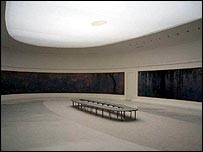
On the ground floor, two large oval rooms are devoted to the fabulous Water Lilies by Claude Monet. Each room contains eight canvases that surround the oval room with a vision of the famous waterlilies at his home in Giverny. A major part of the renovation was the removal of the second floor of the museum which had been added in the 1960's and blocked the natural light that Monet had cherished. Because of the large size of the paintings (painted for these rooms), they could not be moved and were left in place during the six years of renovations. The curator was quoted as saying:
"The most important thing for us was the restoration of natural light,
which was so fundamental to Monet. The study of light is the basis of the
Impressionist movement, so we wanted to restore that as the essence of this
building, which was once described as the Sistine Chapel of Impressionism".
Musee l'Orangerie
Place de la Concorde